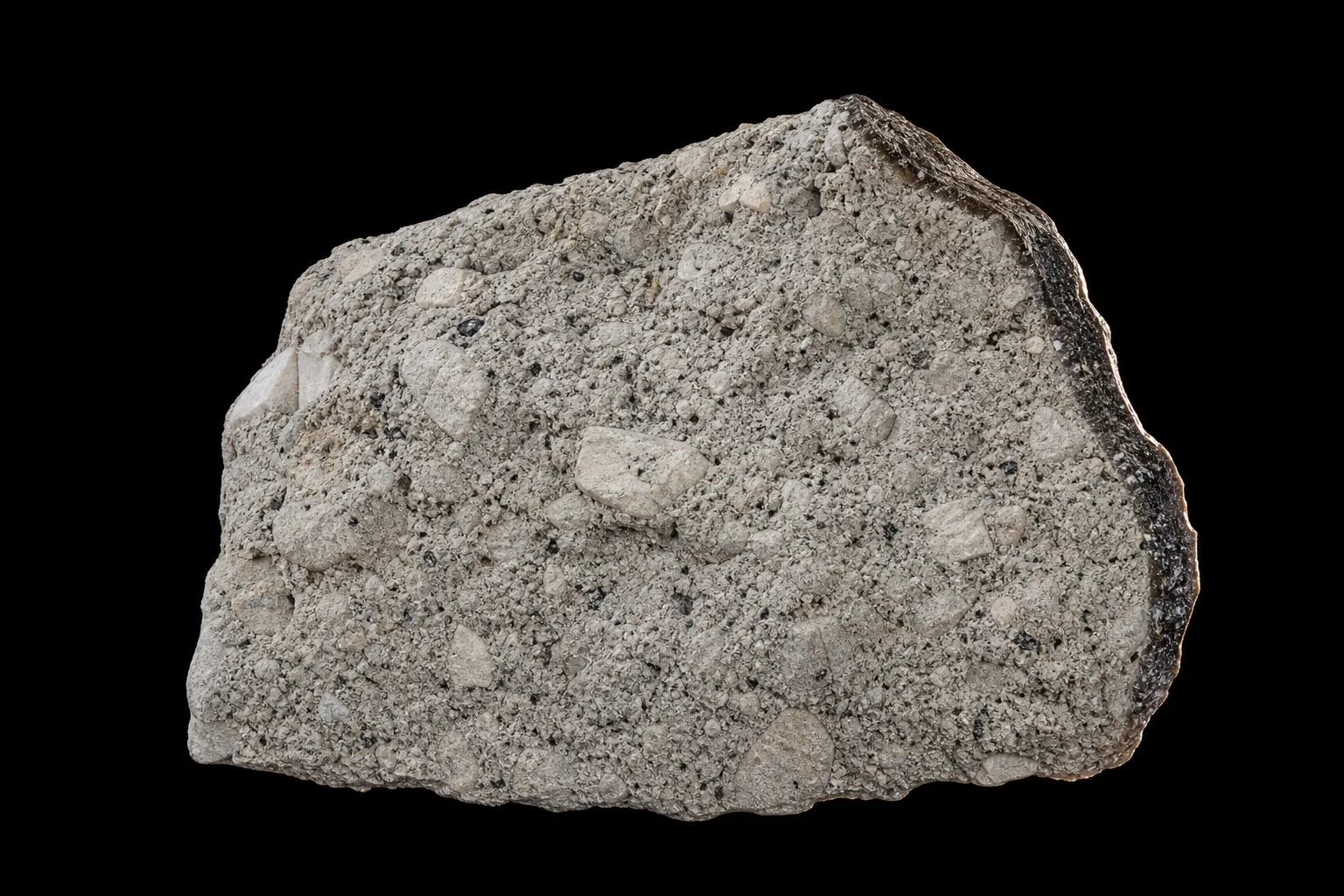
This is a fragment of the Moon that reached Earth on its own. An asteroid strike on the lunar surface flung debris fast enough to escape lunar gravity; some of it wandered the inner solar system for a while and then fell here, where it was picked up off the desert. We know it is lunar because its mineralogy and oxygen-isotope signature match the samples the Apollo missions carried home — there is no faking that match.
Mare Frigus is a feldspathic breccia: pale, chalky, shot through with angular white clasts and a thin glassy fusion rind. It is not much to look at next to a pallasite, and that is not the point. The point is that it is the Moon, in a sealed micromount, sold by the gram at a price that reflects just how little lunar material exists in private hands.
We grade it 9.4 on rarity and documentation alone. Every piece ships with its classification reference and a statement of the mass and pairing, because with lunar and Martian material the paperwork is as much of the specimen as the rock.